

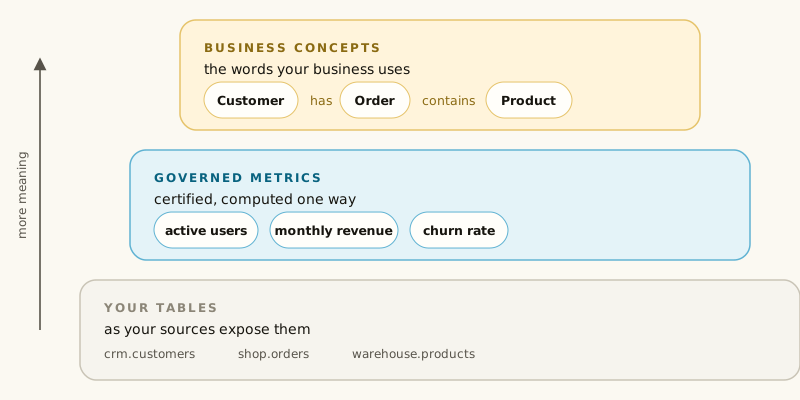
- Models — a model binds one table and names the measures, dimensions and joins you may compute from it. A metric is a named, reusable way to compute a number, built from those measures.
- Ontologies (concepts) — a concept is a business idea like “Customer” or “Order”, with typed properties and explicit relationships to other concepts. A concept can be realized by several semantic models at once, which is what a single model cannot express on its own.
Both tabs need the semantic layer entitlement, but Semantic layer is in the sidebar when the component is deployed,
whatever your tenant’s plan. Opening it without the entitlement refuses the read: you’ll see
“Couldn’t load semantic models” with “this tenant does not include the semantic_layer
entitlement” underneath. Check your plan on Settings → Plan if you
expected to see this feature.
The objects
From draft to certified
Every model, metric and concept moves through the same four states:
A few things about this that are easy to get wrong:
- Editing and certifying are different jobs, held by different roles. Anyone who can edit a model can propose it for review; only a role with certification rights can bless it.
- A model under re-review keeps answering. If a certified model is edited and proposed again, its status becomes “Proposed” while the previous certified version keeps serving every query, unchanged, until the new version is certified. Status describes where the definition sits in review; it does not describe what is currently being served.
- Certifying always names an exact version. You cannot certify “whatever is current” — this stops an edit that lands between review and clicking Certify from being blessed without anyone having seen it.
- There is no separate reject button. Editing a proposal sends it back to draft. Fixing a proposed definition is the rejection, and it is recorded as one.
Who can do what
Access is checked per object type — a “SemanticModel” grant and a “Concept” grant are separate, so a role can read or author one without the other.How a compiled query actually runs
Asking a metric does not run it against a warehouse from the semantic layer itself. Instead:- The semantic layer turns your question (which metrics, grouped by what, filtered how) into SQL for one of your query engines.
- That SQL runs on the engine you pick, under your own access — the same row filters, column masks and table grants that apply to any other query you run apply here too.
- If you cannot see a table a model is bound to, that model behaves as if it does not exist for you.
What agents get
Agents reach the same vocabulary through MCP tools: they can list and read certified models, ask a metric, and read the ontology to find out what a business word means and which models realize it. Agents cannot certify anything — the only way an agent changes the vocabulary is by filing a suggestion for a person to review. See MCP tools for the full list.Related
Create models and metrics
Bind a table, define measures and dimensions, and build a metric.
Ontology concepts
Define business ideas that span more than one dataset.